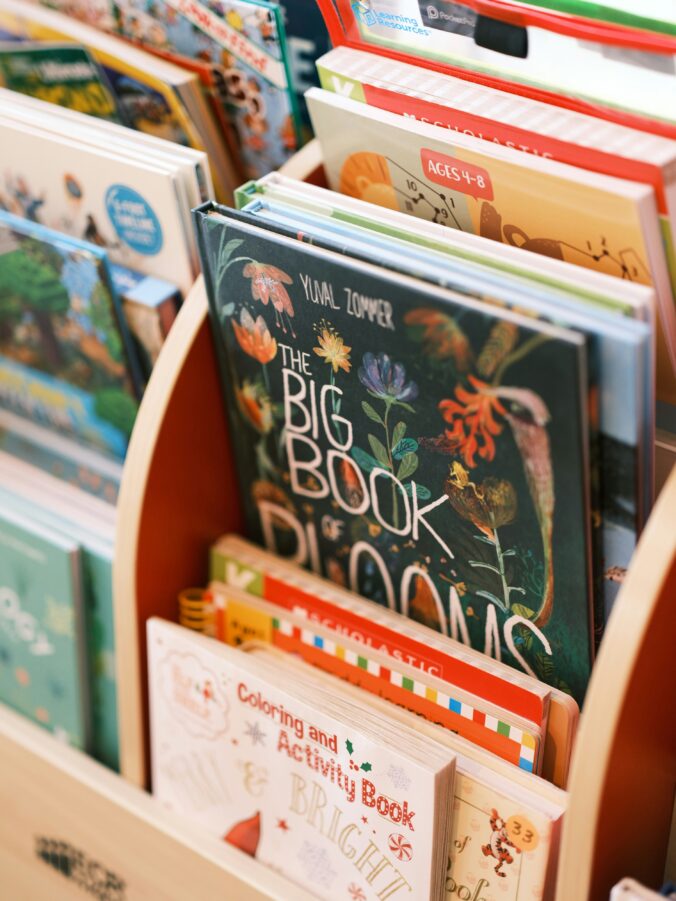
Our professor gave each of my peers and I a piece of paper that had one of the BC Curriculum Science concepts from Kindergarten to Grade 9. Around our classroom, she had set up a whole bunch of different picture books that were a wide variety of topics. Our task for this activity was to read our assigned content from the BC Curriculum and find the picture book that best connected to it. We then went around the room and told our peers and instructor what we were thinking with our choice of book.
This activity was super fun to get ideas for lessons and to see what kind of books could connect to the science curriculum. There really are no limitations.
I chose to include this experience in my blog because it changed how I see resources for teaching science. It showed me that picture books are not just ‘add ons’ but powerful tools for engaging students in the content and allow them to see the full picture of the lesson. Even though books were not under the ‘science’ subject, I learned that a lot of book still were able to connect to scientific concepts. Stories about animals, change, seasons, identity, etc. could all be linked back to the BC Curriculum Science Big Ideas and Curricular Competencies.
This activity was engaging and transformative. It expanded my understanding of what counts as a science resource. I began to see that science topics are embedded in stories, lived experiences, and in natural curiosity that picture books spark within students.
My AHA Moment:
My biggest AHA moment was realizing that there is a book for every concept for all ages. Before this experience, I only used picture books in my lessons as an introductory but now, I can see how some picture books are the lesson and then I can plan an activity that will go with what the book was talking about. This will change how I will plan my science unit for my practicum. I am going to try and teach and revisit concepts through stories. Additionally, using picture books for introducing a concept will reach different learners while still meeting science outcomes. Lastly, another one of my AHA moments were how stories can support science in multiple ways, talking about lifecycles, scientific practices (observations, questioning, predicting, etc.), and of course different animals. Picture books allow students to visualize their learning.
Here is a link I found that has a great amount of picture books recommended for Science!
Connection to the BC Curriculum:
Picture books connect to the BC Curriculum in many ways.
Big Ideas: They can provide concrete examples that help students grasp the Big Ideas such as systems, change, adaption, etc.
Curricular Competencies: Picture books/ stories often model:
- Questioning and predicting
- Observations and describing
- Making connections
- Communicating ideas
Core Competencies: Picture books also support core competencies through discussion and reflection, critical and creative thinking, and lastly, personal and social awareness.
Reflection
This experience has made me reflect on equity and accessibility in science education, especially in today’s context where many students are experiencing increased academic challenges. Traditional science instruction is taught for students who are strong readers and can understand complex texts, and students who have good critical thinking skills. I feel like picture books lower the barrier and make it accessible for all students to get the full understanding as picture books provide visuals, narrative, emotions, and discussion. I also think that bringing a picture book to science lessons allows for students to be engaged as they will connect with certain aspects of the story and gain a passion for those problems.
Moving forward as a teacher candidate, I want to be intentional about using picture books. I plan to use them to introduce new concepts, revisit stories when reviewing the key ideas, make my planning cross curricular, use them to get interest in inquiry projects, connect the learning to the outdoors, etc.