February 17, 2026
Today I am going to compare two different reflective cycles (Boud’s and Gibbs) then I will use one of the reflective cycles to reflect on one of my situations this year in one of my classes.
UVIC Teacher Competencies
This activity for my WordPress relates to Teacher Competency number 2. It links to competency number 2, develop a growth mindset demonstrated in collaboration with others, because I am using Boud’s reflective cycle to analyze my own teaching experiences, I identify what I have learned throughout that experience and created concrete changes for my future of teaching. I also have demonstrated collaborative, ongoing professional learning throughout this post. Additionally, it relates to UVIC Teacher Competency number 12, develop and understanding of how learners learn in order to cultivate effective learning environments. By using feedback to build on and my prior use with the Gibbs cycle has helped me deepen my reflections over the Teacher Education Program.
Boud’s Reflective Cycle

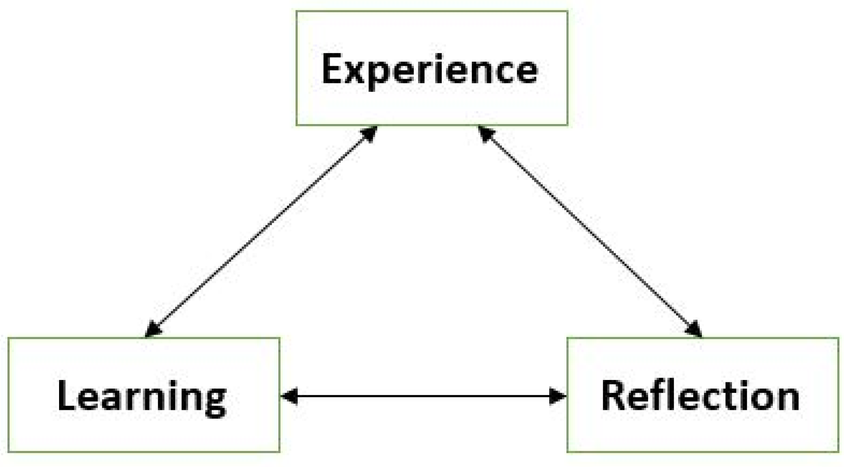
Boud’s Reflective Cycle is a simple three step model that leads to what you learned from the experience and how it will shape your future thoughts, knowledge, experiences, and create new connections to past information. Boud’s reflective triangle is a faster reflection style that still supports personal and professional growth. In my third year of the EKTEP (East Kootenay Education Program) I feel like I use more this style.
Gibbs reflective cycle
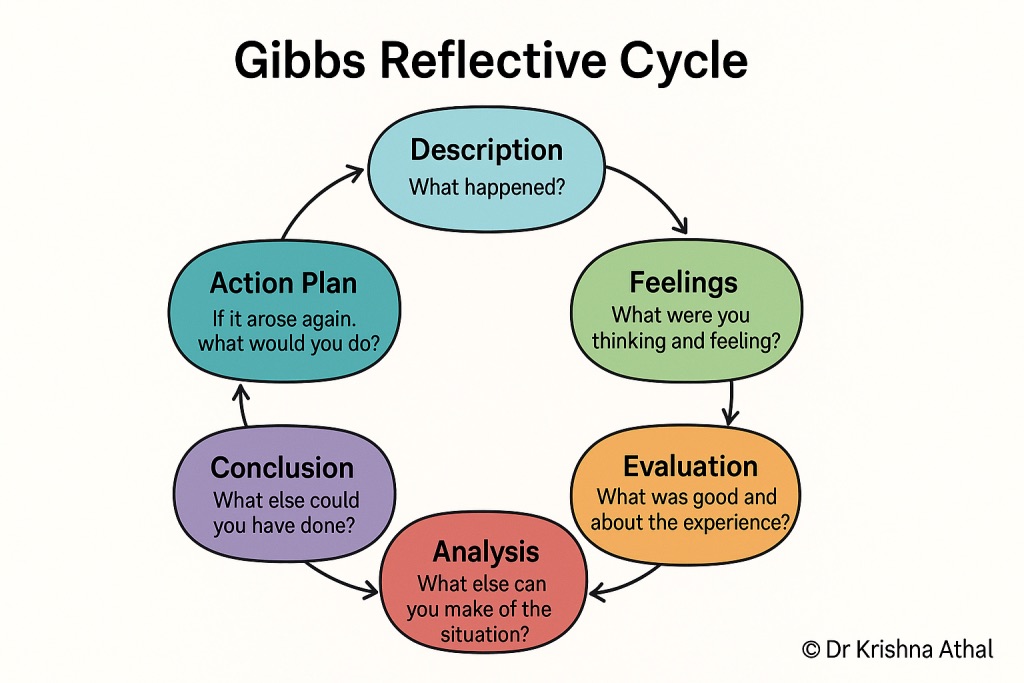
Gibbs reflective cycle is a six step reflection where you go through describing, your feelings, evaluating your experience, your analysis, conclusion, and your action plan for future experiences. This cycle helps guide you through a step by step reflection. The Gibbs cycle encourages deep, critical thinking to help improve your skills, and behaviours for your next experiences. This is the model that my cohort and I had to do for our second year of the program to create deeper reflections.
Similarities:
- Both focus on learning from experience
- Both encourage thinking about your thoughts, feelings, and actions
- Both of these reflective cycles want to improve your future practices
- Both support professional growth and reflection
Differences:
Gibbs:
- Very structures with its six stage reflection steps
- Gives people a step by step thought process
- Occurs in a cycle (going through the stages of the reflective cycle over and over again)
Boud’s:
- Not very structured (only has three main steps)
- More flexible with instruction
Boud’s Reflective Cycle Science Paper Airplane Demonstration:
I chose to do this reflective triangle with my experience because like I have said before, I have done the Gibbs reflective cycle so I think that it will be beneficial if I try something new. I also used feedback to build on my prior knowledge with the Gibbs cycle which has helped me deepen my reflections over the Teacher Education Program. I feel like it is engraved in me to reflect on everything that I present or teach which helps me with my own growth mindset.
Experience – Some of my peers and I presented a demonstration on paper airplanes to my class. We used student volunteers to show how variables can impacts Newtons three laws of motion. During our presentation of our demonstration, I noticed that the peers who were not participating were not as engaged as our participants.
Reflection – Before presenting with a couple of my peers I felt nervous as we have never done a demonstration before but I knew we went above and beyond with our handouts and that we were prepared for our presentation to be successful. The more my group and myself spoke, I felt more confident in our presentation. After we finished the presentation, I was glad that we were one of the first groups to present. Something that always makes me nervous after a presentation is the mark. I am a perfectionist and I like to get the best possible grade. But once we received our mark I was relieved. I think I was so nervous about our mark because the people who went after us did a really good job which was making me second guess myself.
Learning – Through this presentation, I have learned that being over prepared helps me build my confidence going in front of a group. I realized that engaging the audience actively and consistently will increase participation and make the demonstration more effective. Next time, I would include the other people who were not participating within the demonstration so that they are not just sitting there. I could do this by getting them to vote which variable they want each airplane to have, etc. I also am still learning that comparing myself to what others do is not good and creates unwanted anxiety. This is an ongoing occurrence for me and is something that I will need to let go, or take there ideas for my future teaching practices. In the future, I will continue to prepare my lessons, units, and demonstrations carefully making sure I am over prepared, involve lots of participants in my presentations/ lessons, and to remind myself to evaluate my presentation based on my own effort rather than others.
Lauren,
It is hard to not compare oneself with others at times! Using a reflective model helps to make sense of the ‘why’, even when it comes to emotions. That is why certain models are better for certain things! Quick and easy (triangular models) help with action when less reflection is needed. Gibb’s is for the deeper ‘stuff’ and delves into the ‘why’ and ‘how’ a bit more. It is important to have a few models in your proverbial tool kit!
Please continue to be a reflective practitioner, it helps make the teaching journey make sense!